
What fairness principles should an election rule satisfy?
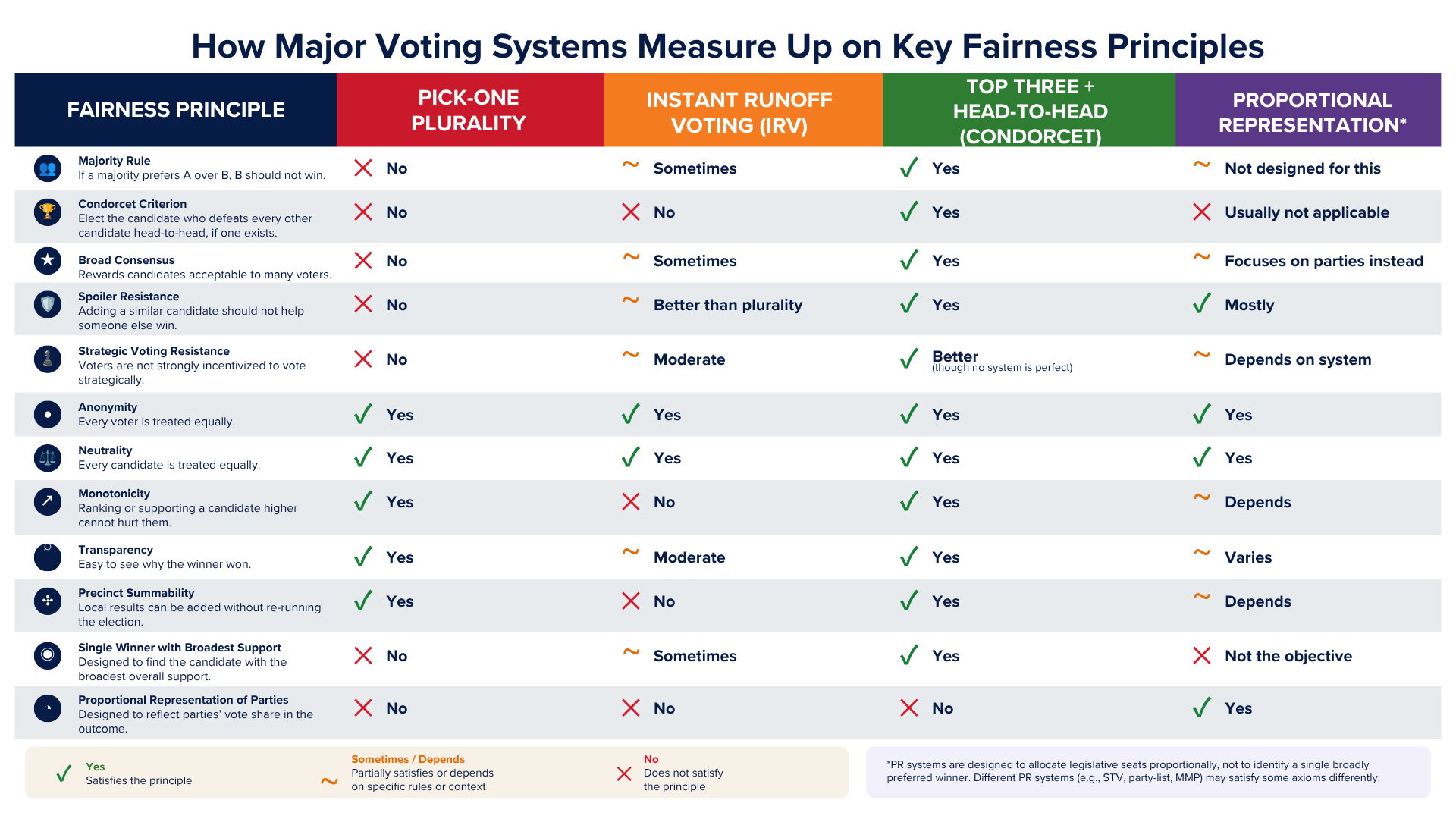
Every election system is really a set of mathematical rules.
Those rules determine whose voices matter, how winners are chosen, and whether candidates are rewarded for building broad support or simply exciting a passionate minority.
Mathematicians, economists, philosophers, and Nobel Prize winners have spent decades studying which rules produce fairer outcomes. Their work is known as social choice theory.
Top Three Elections with head-to-head voting is based on many of the principles that this research identifies as desirable.
Instead of inventing a voting method first, mathematicians identify desirable properties and then prove which methods satisfy them.
The Mathematical Principles Behind Top Three
1. Majority Rule
If most voters prefer Candidate A over Candidate B, Candidate B should not become the winner. This seems obvious—but surprisingly, not every voting system guarantees it.
Top Three compares every finalist directly against the others using the ranked ballots. If one candidate would defeat every other finalist in one-on-one contests, that candidate wins.
This is known as the Condorcet principle, which Eric Maskin, Edward Foley, Wesley Holliday, and Eric Pacuit argue is one of the strongest democratic principles available.
2. Every Vote Counts Equally
Every voter has exactly one ballot.
Every ballot is counted using the same mathematical rules.
The identity of the voter never changes how the ballot is treated.
Mathematicians call this anonymity.
3. Every Candidate Is Treated Equally
The rules do not favor Republicans.
They do not favor Democrats.
They do not favor Independents.
They do not favor incumbents.
If you swapped the names of two candidates on every ballot, the outcome would swap as well.
Mathematicians call this neutrality.
4. Winning Requires Broad Support
Top Three rewards candidates who can defeat multiple opponents—not merely finish first with a passionate minority.
The winner must demonstrate broad support across the electorate.
Eric Maskin often describes this as encouraging compromise candidates rather than polarization.
5. The Rules Resist Spoilers
Adding another similar candidate should not unfairly cause someone else to lose.
Many voting systems fail this test.
Top Three dramatically reduces spoiler problems because voters express a preference in head-to-head matchups and winners are determined by comparing candidates one-on-one.
Recent work by Holliday and Pacuit explicitly develops axioms designed to reduce spoiler effects in preferential voting.
6. The Rules Are Difficult to Game
Good election rules should reward honest voting more than strategic voting. Charles Munger Jr. has argued that Condorcet-consistent systems are substantially more resistant to tactical manipulation than systems like Instant Runoff Voting in three-candidate elections.
No voting system is completely strategy-proof—this is impossible under the Gibbard–Satterthwaite theorem—but some systems create fewer incentives for strategic behavior than others.
7. The Rules Are Consistent
If Candidate A defeats Candidate B in a majority vote, the election system should recognize that defeat.
Holliday and Pacuit argue that democratic election systems should define winners through coherent majority defeats rather than arbitrary elimination rules.
Why Not Just Pick One?
The winner is determined based on receiving most first-place votes even if they do NOT receive a majority (50% or more) of votes. This means:
someone can win with far less than a majority,
vote splitting becomes common,
spoilers become possible,
broadly acceptable candidates often lose.
Eric Maskin has repeatedly used these failures as motivation for adopting Condorcet-style voting methods.
Why Isn't Instant Runoff Enough?
Instant Runoff Voting (IRV) collects ranked ballots, but it does not compare every candidate head-to-head.
Instead, it repeatedly eliminates the candidate with the fewest first-choice votes.
That means:
a broadly preferred candidate can be eliminated before important comparisons occur,
the winner may lose a head-to-head election against another finalist,
elimination order can determine the outcome.
Anomalous outcomes have occurred in Alaska, Burlington, Vermont and Moab, Utah.
